What Is Earth s Distance From the Sun Again
How far is World from the sun?
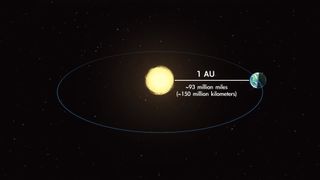
Earth travels effectually the sun in an orbit that is slightly oval-shaped, known as an ellipse. Therefore, the planet'southward altitude from the sunday changes throughout the year.
Withal, the average altitude from World to the lord's day is almost 93 million miles (150 meg kilometers). Scientists also phone call this altitude one astronomical unit (AU).
The universe is a big identify, and sometimes researchers use the astronomical units to communicate how far celestial objects are separated from i some other. For instance, Jupiter orbits about 5 AU from the sun.
Related: How big is Earth?
Related: What'due south the speed of Globe around the lord's day?
Earth's altitude from the sun changes
In early January, World reaches its closest position to the star. Astronomers telephone call this point perihelion, and at this fourth dimension Earth is about 91.4 million miles (147.ane million km) away from the sun, according to NASA.
Keep in mind that Earth's distance from the lord's day does not determine the seasons we experience; the seasons are determined by the tilt of the planet's axis. This is why the season occurring in Earth'due south Southern Hemisphere is ever in opposition to the season in the Northern Hemisphere.
Half a yr after perihelion, Earth reaches its farthest distance from the star, which is called aphelion. At that moment, the planet is approximately 94.5 million miles (152.1 million km) from the sun. Aphelion occurs in early July.
Perihelion and aphelion average out to nigh 93 meg miles (150 one thousand thousand km).
A new, more precise astronomical unit
The International Astronomical Matrimony (IAU) is an international nonprofit organization that is tasked with, amid many other things, defining astronomical constants. In August 2012, IAU members voted to approve a more exact measurement of 1 AU.
An astronomical unit of measurement is now more precisely defined as "a conventional unit of length equal to 149,597,870,700 meters exactly." That translates to roughly 92,955,807 miles (149,597,871 km).
Why was this decision necessary? The equation that had previously adamant the value of an AU depended on information including the mass of the sun. Simply that value changes considering the star is constantly transforming its mass into energy, according to 2012 reporting past Nature.
Einstein'south theory of general relativity also throws a wrench in the evaluation of an AU considering it argues that space-fourth dimension is relative depending on the observer's location in the solar arrangement. This complication made it difficult for planetary scientists working on models of the solar system.
The IAU'southward recently-adopted value is measured using the speed of light in the vacuum of infinite, which is constant.
The original adding
The offset-known person to mensurate the distance to the sun was the Greek astronomer Aristarchus of Samos, who lived from well-nigh 310 B.C. to 230 B.C. He used the phases of the moon to measure the sizes and distances of the sun and moon.
He postulated that when the one-half moon appears in Earth's sky, the heart of our planet and the middle of the moon create a line in infinite that forms a 90 degree angle with some other line that could be drawn through infinite from the moon's eye all the way to the sun'south center. Using trigonometry, Aristarchus could decide the hypotenuse of a triangle based on those two imaginary lines. The value of the hypotenuse would provide the distance between the sun and the Earth.
Although imprecise, Aristarchus provided a simple understanding of the sizes and distances of the three bodies, which led him to conclude that the Earth goes around the sun, almost 1,700 years earlier Nicolaus Copernicus proposed his heliocentric model of the solar arrangement.
In 1653, astronomer Christiaan Huygens calculated the distance from World to the sun. Much like Aristarchus, he used the phases of Venus to discover the angles in a Venus-Earth-sun triangle. His more than precise measurements for what exactly constitutes an AU were possible cheers to the beingness of the telescope.
Guessing (correctly, by chance) the size of Venus, Huygens was able to make up one's mind the altitude from Venus to Earth. Knowing that distance, plus the angles made by the triangle, he was able to measure the distance from Earth to the sun. However, considering Huygens' method was partly guesswork and non completely scientifically grounded, he unremarkably doesn't get the credit.
In 1672, Giovanni Cassini used a method involving parallax, or angular difference, to find the altitude to Mars and at the aforementioned fourth dimension figured out the altitude to the sun. He sent a colleague, Jean Richer, to Cayenne, French Guiana (located just northwest of the mod-day Guiana Space Centre nigh Kourou) while he stayed in Paris. At the same fourth dimension, they both took measurements of the position of Mars relative to background stars, and triangulated those measurements with the known distance between Paris and French Guiana. Once they had the distance to Mars, they could besides summate the distance from Earth to the sun. Since his methods were more scientific, Cassini usually gets the credit.
These techniques are also why astronomers continue to use the distance from Globe to the sunday every bit a calibration for interpreting the solar system.
"Expressing distances in the astronomical unit immune astronomers to overcome the difficulty of measuring distances in some physical unit," astronomer Nicole Capitaine of Paris Academy told Space.com. "Such a practice was useful for many years, because astronomers were not able to brand distance measurements in the solar system as precisely as they could measure angles."
Across the solar system
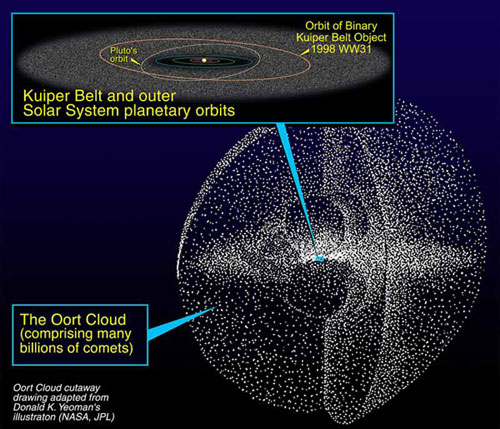
The sun is at the centre of the solar system. All of the bodies in the solar system — planets, asteroids, comets, etc. — revolve effectually information technology at various distances.
Mercury, the planet closest to the sun, gets as shut as 29 one thousand thousand miles (47 1000000 km) in its elliptical orbit, while objects in the Oort Cloud, the solar system'southward icy beat out, are thought to prevarication as far as nine.three trillion miles (15 trillion km).
Everything else falls in between. Jupiter, for instance, is 5.2 AU from the dominicus. Neptune is xxx.07 AU from the sun.
The distance to the nearest star, Proxima Centauri, is about 268,770 AU, co-ordinate to NASA. Nonetheless, to measure out longer distances, astronomers apply light-years, or the distance that low-cal travels in a single World-year, which is equal to 63,239 AU. And so Proxima Centauri is about four.25 light-years away.
Boosted resource and reading
Watch a video explaining Aristarchus' approach to computing the distance from Earth to the sunday. NASA's lord's day fact sail provides bones statistics about our star and its solar system exploration page offers details virtually solar science and missions studying the lord's day. You tin can too explore cosmic distances, within the solar organization and beyond, with NASA.
Bibliography
- Brumfiel, G. "The astronomical unit gets fixed." Nature (2012). https://www.nature.com/articles/nature.2012.11416
- International Astronomical Wedlock, "Measuring the Universe," accessed Jan. 21, 2022. https://world wide web.iau.org/public/themes/measuring/
- Kish, M. "A Source Book in Geography," accessed via Google Books. Harvard University Press, 1978.
- Luque, B. and Ballesteros, F. "To the Sun and beyond." Nature Physics (2019). https://www.nature.com/manufactures/s41567-019-0685-iii
- NASA, "What Causes the Seasons?" July 22, 2021. https://spaceplace.nasa.gov/seasons/en/
Join our Space Forums to keep talking infinite on the latest missions, night sky and more! And if you lot have a news tip, correction or comment, let us know at: customs@space.com.
Source: https://www.space.com/17081-how-far-is-earth-from-the-sun.html
0 Response to "What Is Earth s Distance From the Sun Again"
Post a Comment