Dante Created His Flashcard and Is Reviewing Them
Flash cards are one of the classic study tools, and for good reason – they promote studying through active recall, which is one of the practices through which our brains learn virtually effectively.
However, many students employ wink cards… well, I don't desire to say they use them the wrong mode – merely they use them in ways that aren't very efficient. Some of the mistakes people make when making and studying flash cards include:
- Making them in a fashion that leverages merely rote memorization
- Creating complex cards that don't forcefulness truthful call back – which leads people to mistake recognition for actual noesis
- Over-using flash cards, or using them when a different tool or study method would be more effective
I want to help you avoid making those mistakes, every bit flashcards can exist very effective when they're used correctly. For example, when I was learning Japanese, I fabricated extensive use of flashcards for studying kanji. Doing then helped me acquire very chop-chop.
You're probably studying a subject correct now that would benefit from flash card written report as well, so it'd be useful to larn the best practices for making and studying those wink cards.
In this article, I'll become over eight of those best practices. Let's get into it.
1. Make Your Own Wink Cards
Lots of people like to share their flash carte decks, and there are likewise plenty of wink bill of fare apps and programs out in that location that will let you download pre-fabricated decks and start studying instantly.
I think using pre-made cards cansometimesexist useful – such as a case where you take an unreasonably high number of facts to larn and you're in a fourth dimension crisis – but in almost cases, you'll serve your brain better bymaking your own flash cards.
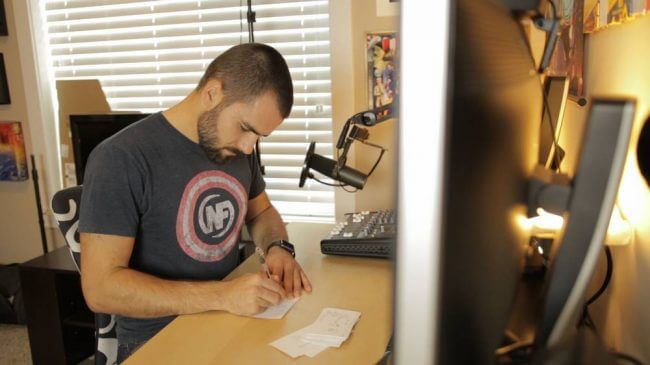
One of the near important and integral parts of the learning procedure is the human action of:
- Intaking new data
- Wrangling with it in your brain
- Creating something new with it – your own words, pictures, and methods of explaining that data
Doing so createsstiff neural pathways,which enable yous to hands call up what yous've learned at a afterward date. That's why i of professor Marty Lobdell'south tips in his Report Less, Study Smart lecture was toteach what you're learning –doing so forces you to present the information in your own words.
When you lot apply pre-made wink cards, you're skipping that entire part of the process. In almost cases, the fourth dimension you save isn't worth information technology.
Plus, deciding to make your own flash cards gives you the power to customize them and brand them better. The next four tips will testify you exactly how.
2. Mix Pictures and Words
Calculation pictures to your cards can make them a lot more than memorable.
In cognitive psychology, there's a concept called the Picture Superiority Upshot, which describes how people tend to remember imagery a lot meliorate than they retrieve words.
When we think about it from an evolutionary perspective, this makes complete sense; written language has merely been effectually for nigh 5,000 years (andHuman being Sapienstake been trotting the globe for over 200,000), and our brains have evolved to be very sensitive to imagery. The locations of food, the animals that want to eat us or stomp us into the footing – these things are far more of import to our brains than abstract squiggles on a page.
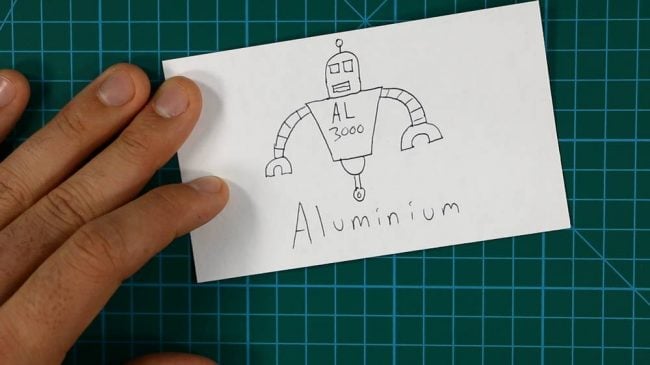
All the same, this doesn't hateful that you shouldsupersedethe words on your cards with pictures. Our brains are surprisingly adaptive, and information technology turns out that amixture of pictures and wordsworks better than pictures lone.
A 1985 report done in Toronto found that:
"A mail-picture sentence improves attention to and perhaps rehearsal of the representation of the moving-picture show post-obit its display."
By adding descriptive sentences – or even unmarried terms – alongside pictures, you can increase your brain's ability to recall what you're studying.
Take my free productivity masterclass
With a proper productivity arrangement, zippo ever slips through the cracks. In just one hour, you'll larn how to set upward your to-do list, calendar, note-taking organization, file management, and more — the smart way.
iii. Use Mnemonic Devices to Create Mental Connections
In training for writing this article, I decided to start learning and memorizing the Periodic Table of Elements.
I thought this would be a fun challenge, since I really never took chemistry in high school, and I find science a lot more interesting at present than I did back and then. Additionally, it gave me the opportunity to make my own flash cards, which I was able to use as examples hither.
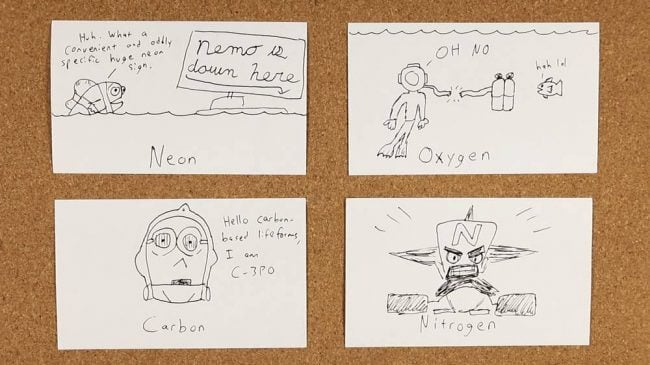
Y'all can meet some of my chemistry wink cards above – and you lot might think they await a bit weird. What the heck do all these dumb drawings have to exercise with elements?
Here's how they're relevant: They'remnemonic devices.Now, a mnemonic devices is anything that helps you build an association betwixt two pieces of information in your mind.
A classic mnemonic that almost anybody knows is ROY G. BIV – the acronym that helps y'all think the society of the colors in the visual light spectrum. Rhymes make good mnemonics, as well. You've probably heard this one:
In 1492, Columbus sailed the ocean blue.
That rhyme fails to convey how awful of a person Columbus was, but it does help u.s.a. remember the date quite nicely.
In addition to acronyms and rhymes, associative images brand for great mnemonics besides. That's what my images are:
- Aneonsign is helping Marlin findNEmo.Ne = Neon
- A diver proverb"Oh no"because hisoxygen line has been cut. O = Oxygen
- C-3Po greetingcarbon-based lifeforms. C = Carbon
- Neo Cortex, who has a bigN on his forehead, is a character in CrashNitroCart. N = Nitrogen
The weirder and wackier your associations are, the more hands you'll remember them. That'south because your brain is adjusted to recall things that are out of the ordinary. It readily deletes mundane things like the chit-chat you lot had ownership your forenoon java, or which Ninja Turtle was on the underwear you put on this morning time.
So feel gratuitous to make your pictures crazy. Also, recollect that y'all're making these cards for you; it doesn't affair if the associations make sense to other people. They should be making their own cards.
four. Write Only One Question Per Card
Let's imagine for a second that you're taking a class on the History of Aircraft. I mean, why wouldn't you? Airplanes are freaking awesome.
Anyway, at present you're studying for an exam and you need to know some information nearly the kickoff aeroplane: The Wright Flyer.
Then you pull out a wink card. On the forepart, you write, "Offset Airplane". Then, on the back, you include a few facts:
- Wright Flyer
- Flew in 1903
- Flew four times
- Used a sprocket chain bulldoze
…and just like that, you're at present the proud owner of abad flash card.Hither's why.
Past including multiple facts on one card, you lot're more likely to come acrossillusions of competence.
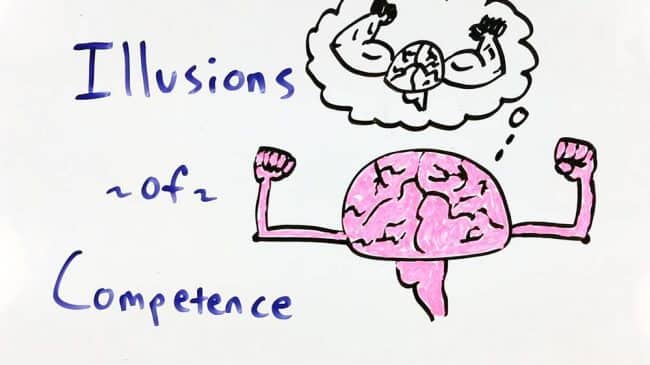
These happen when you think yous know something that yous actually don't – a situation that normally arises when your brain mistakesrecognitionforrecall.
Our brains arereallygood at recognizing things we've seen before. Nevertheless, recollect isn't the same thing – recollect is the human action of retrieving something from memory without an explicit cue.
When you lot written report a flash card with multiple facts on it, you hazard making this mistake. Say you pull out your "First Aeroplane" bill of fare later on on during a study session. You're going speedily, and your encephalon readily pulls upwardly the starting time three facts. Wright Flyer… bank check! 1903… double cheque! Flew four times… easy.
You forgot about the sprocket chain drive… just then you turn the card over, see it listed with the other facts, and say to yourself:
"Oh yes, I knew that."
…and so you lot move on. You feel like y'all know the carte du jour since you got itmostlyright, and because yourecognizedthe 4th fact.
By ensuring that each of your cards only contains 1 question or fact, you won't come across this mistake.
Looking for more than study tips? Check out this master list.
5. Break Complex Concepts Into Multiple Questions
This tip builds off of the previous one, but it'southward of import plenty to take its ain spot on the list.
See, some concepts or ideas are too circuitous to be encapsulated in one question. These kinds of concepts need to exist broken downward intomultiple questionsin society to be studied well using flash cards.
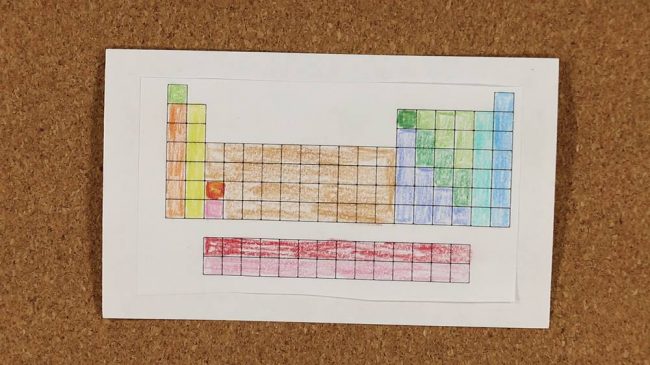
Take the carte du jour above. I've colored the Periodic Table this way in club to stand for the different groupings of elements – which is a slap-up way to start memorizing those elements.
Technically, we could build one question here:
"What are the chemical element groupings on the Periodic Tabular array?"
But, turning the menu over, nosotros see this:
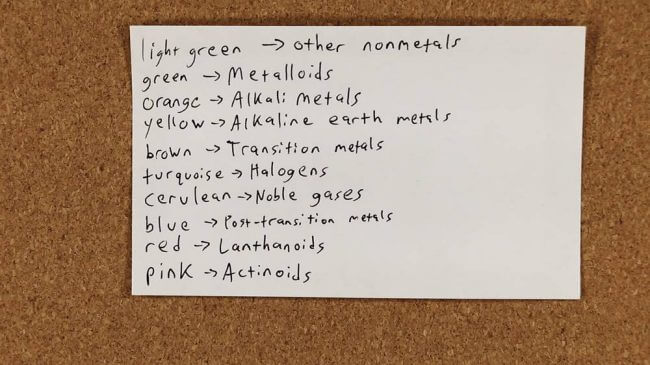
Once more, we've got a menu that invites those peskyillusions of competence.Mayhap you tin can name all simply one of the chemical element groupings – but the last one might tag forth and masquerade as a fact you tin can recall.
Alternatively, if you fabricated card that only asked for1of those element groupings, you'd know for sure whether you got information technology right or wrong once you turned that card over.
6. Say Your Answers Out Loud When Studying
When I've studied with wink cards in the past, I've ever studied them by myself – and I did so silently.
Equally a upshot, I'd go annoyed when my girlfriend would ask me to run through her art history flash cards with her. At present, though, I realize she was onto something – past having me quiz her on her cards, she was forced to say her answers out loud and have me verify them.
This is notwithstanding another way to keep those illusions of competence at bay, as at that place was no way to fudge the answers.
Even so, if you don't have a buddy or reluctantly willing significant other around to quiz you, you can get a lot of the same benefits past just proverb your answers out loud before flipping your flash cards. That way, y'all're committing to your answer before checking information technology.
vii. Study Your Flash Cards in Both Directions
When y'all're studying your flash cards, make sure you review them from both sides. By doing this, y'all're going to build stiff neural pathways that tin be traced easily in both directions. It's kinda like learning to skate in both regular and goofy stances:

If youdon'tdo this, you lot increment the probability that you'll but be able to remember a i side of a card hands.
For case, the chemic symbol for the chemical element beryllium is Exist. If yous've got a wink carte du jour with the symbol and the chemical element name on either side, merely yous simply e'er ask yourself, "What does Exist stand for?", and then you might run into a test question like:
"What'south the chemical symbol for beryllium?'
…and totally choke on the answer. So build those bi-directional pathways, friend.
eight. Don't Treat Flash Cards Like a Silver Bullet
Remember that flash cards are butonemethod of reviewing fabric. In that location are lots of others that may be more effective, depending on what type of material you lot're studying and how far you are into the learning process.
Instead of using wink cards, yous might:
- Write an explanation in your own words
- Create a quiz
- Take a do examination written by someone else
- Work lots of practice issues (your get-to strategy for math)
- Brand mind maps or Venn diagrams
Wink cards are very good at helping y'all drill relationships betwixt two pieces of information – but that'south information technology. That makes them proficient for learning definitions, vocabulary words, etc – just it makes them a peculiarlybadstudy tool for information that fits into a larger visual or organizational hierarchy.
For example, imagine trying to learn all theatomic numbersof the elements of the Periodic Tabular array using flash cards. You'd accept to relyentirelyon mnemonics to do that; in that location'south no obvious connection between the numbers and the chemical element names. Magnesium is pretty like shooting fish in a barrel to necktie to Mg – but it's not piece of cake to necktie to the number 12.
Moreover, the layout of the Periodic Table is much more than constructive for learning those numbers. Past learning the groupings and using other mnemonics, you tin quickly get to the point where filling in the entire tabular array from memory becomes easy. From at that place, you lot tin can but option a box and figure out its number.
Better Flashcards Hateful Amend Studying
Hopefully these tips will help yous brand meliorate flash cards in the hereafter, no matter what subject field yous're studying.
Looking for apps to go far easier to study and manage your flashcards? Check out this guide.
Source: https://collegeinfogeek.com/flash-card-study-tips/
0 Response to "Dante Created His Flashcard and Is Reviewing Them"
Post a Comment